Or Hadash: A Reconstructionist Congregation is a synagogue located in the northwest suburbs of Philadelphia (Upper Dublin Township, southeastern Montgomery County, Pennsylvania), about a half mile from Exit 339 (Fort Washington) of the Pennsylvania Turnpike, and about a 35 minute drive from either northeast or center city Philadelphia. (It is about 10 minutes from Arcadia University at Easton and Church Rds., in Glenside, PA.)
Driving directions below, but
CLICK HERE FOR GOOGLE MAP (Opens in a new window)
From the Pennsylvania Turnpike
From either direction, get off at Exit 339 (formerly 26)
Fort Washington. Go straight, following signs towards Fort Washington/Oreland.
Turn left at the first light onto E. Pennsylvania Avenue. At the second traffic
light, turn left onto Camp Hill Road. We are the second driveway on the left.
From Route 309 Southbound
Take the Fort Washington/Oreland exit and go straight across at the traffic
light on E. Pennsylvania Avenue. At the second traffic light, turn left onto
Camp Hill Road. We are the second driveway on the left (brown sign).
From Route 309 Northbound
Take the Fort Washington/Oreland exit. Bear right at end of ramp and get
immediately into the left lane. Turn left at the first light onto E.
Pennsylvania Avenue. At the second traffic light, turn left onto Camp Hill Road.
We are the second driveway on the left (brown sign).
From Elkins Park
Go West on Route 73 (Church Road).
Right onto Valley Green Road (first traffic light after you go under Route 309
overpass).
Right onto Camphill Road.
Turn right onto Pennsylvania Avenue and make an immediate left at the next
traffic light back onto Camphill Road.
Second driveway (Gay Way) on the left is Or Hadash (brown sign).
From Abington
Susquehanna Road to 152 South.
Left on 152.
Right onto Dreshertown Road (first road on the right).
Follow Dreshertown Road to the end. Turn left onto Camphill Road.
Right onto Gay Way (first driveway at the bottom of the hill) is Or Hadash
(brown sign).
From Blue Bell
Go East on Route 73.
Turn left under the bridge onto Camphill Road where Route 73 meets Bethlehem
Pike (Bent Elbow).
Follow Camphill Road to the traffic light (road winds, about 2 miles).
Turn right onto Pennsylvania Avenue and make an immediate left at the next
traffic light back onto Camphill Road.
Second driveway (Gay Way) on the left is Or Hadash (brown sign).
From Center City
Schulkill Expressway (I-76) West to the Blue Route (I-476).
476 North to PA Turnpike.
Turnpike East to Ambler/Fort Washington Exit 339 (formerly 26) (next exit).
Go straight, following signs towards Fort Washington/Oreland. Turn left at the
first light onto E. Pennsylvania Avenue. At the second traffic light, turn left
onto Camp Hill Road. We are the second driveway on the left (brown sign).
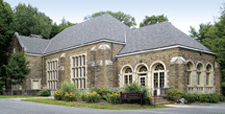
Or Hadash is a synagogue located at 190 Camp Hill Road, Fort Washington, PA. It is the former Cadwalader Mansion. It was purchased by Richard M. Cadwalader, of a socially prominent Philadelphia family, and Emily Roebling, granddaughter of the designer and builder of the Brooklyn Bridge, when they were married.
The affluent couple spent weekends and summers in the mansion, built in 1888 with more than 20 rooms. In 1923, they added on to the mansion, which they had named Fairwold, because they thought it was too small.
When Emily died in 1942, Richard sold Fairwold to his real estate agent, George B. Gay. Gay lived in the building briefly, then divided it with a fire wall and donated half of it to the Oreland Baptist Church in the 1940s. Because of provisions made by Gay in his will, the mansion was to be forever used for worship.
The building boasts a beautiful sanctuary with an organ loft as well as a piano. Ten-foot French doors and windows open to a high-ceilinged solarium. The sanctuary was the ballroom of the original mansion, so it is perfect as a multipurpose room, and serves as a place of worship, synagogue social room, the venue for a performing arts series (it has superb acoustic qualities for music) and as a dance floor for folk dancers.